A Surviving Facts Blog
I have never been a conspiracy theorist. I don’t believe in an evil government cabal led by one political party (statistically, what are the chances?) with the intention to suck blood from babies. While a sect of the far right has claimed democrats are “all” child molesters, the only trend I’ve seen is of politically right-wing politicians accused of sexual misconduct- Cavanaugh, Gaetz, Hegseth, RFK Jr., McMahon, Musk, even Trump himself. In addition, Catholic priests and Southern Baptist ministers have reportedly sexually abused thousands of children. I know of no similar far left group with such accusations. Likewise, I’ve seen no pictures of Biden with Epstein (other than a fake one), while I’ve seen many real pictures of Epstein with Trump, with whom he shared a close friendship. Based on this evidence alone, I could suggest that child molesters tend to hide among the (religious) far right. That’s not what this blog is about, however, though perhaps it should be.
If there is any “secret” society we Americans need to be concerned about, it’s a not-so-secret “band of billionaires” (my words), which seems to own everything, including each other, and work together to make one another wealthier.
I recently watched a Facebook reel (from TikTok ) that mapped this out. Essentially, the narrator Ian Carroll demonstrates that the world’s wealthiest investment companies and the world’s mega companies own each other in such an intertwined way that individual investors and even owner investors have very little impact on these institutions and companies. Through intertwined ownership, these investors ensure each other’s success and prevent transparency. They are essentially passing money among themselves.
The word “mega company”- what big conglomerates are now called- is just another word for monopoly. These mega companies own their markets and each other.
Who owns mega companies? BlackRock, Vanguard, State Street, Geode Capital Management, Bank of America, Morgan Stanley, JP Morgan. These institutions own major portions of megas such as Walmart, Target, Costco and Albertsons’. They also own significant portions of tech megas Microsoft, Apple, Amazon and Nvidia.


Now ask who owns BlackRock, Vanguard, State Street, JP Moran and Morgan Stanley? It’s the same list. BlackRock, Vanguard, State Street, Geode Capital Management, Bank of America, Morgan Stanley, JP Morgan., and many of the mega companies listed above. They own each each other.
For example, the top institutional investors of BlackRock are Merrill Lynch, Vanguard, BlackRock, State Street, Bank of America, Morgan Stanley. Collectively, they own more than 75% of BlackRock. BlackRock, in return, owns pieces of many of these.
Who owns Merrill Lynch? The same list. Who owns Vanguard? The same list. Bank of America? Ditto. State Street? Yep, the same. Amazon? Want to take a guess? Albertsons? The same.
THEY ALL OWN EACH OTHER. (Emphasis intended.) Mega corps own mega corps. It’s one big monopoly.

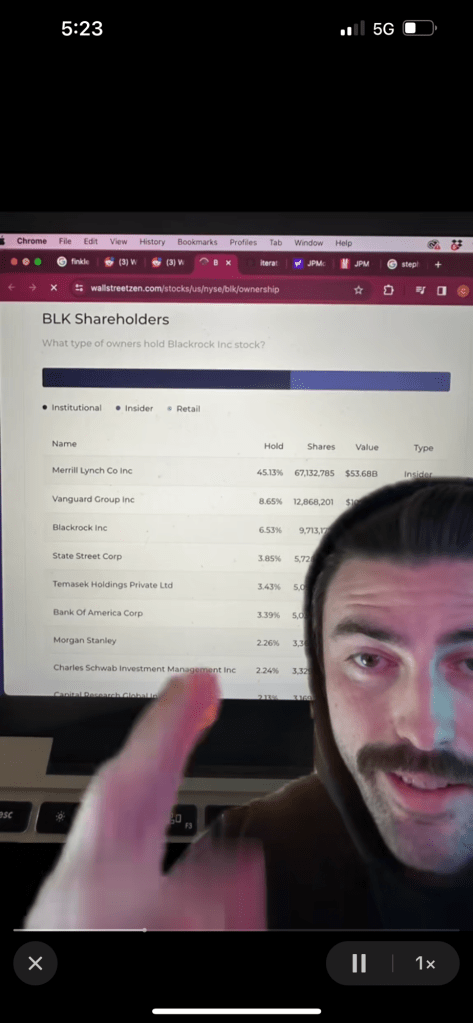
What does this mean for our economy? when mega corporations own each other in such an intertwined fashion, their goals and interests align. Want to raise prices? It’s good for all of us billionaires, so let’s do it. Want to inflate the stock market? We can raise prices to increase one another’s shareholder value so we all grow simultaneously together. And together, these mega investors collectively become billionaires and get richer and richer and richer.
BlackRock wants JP Morgan to do well because JP Morgan owns them, and vice versa. I’ve shared photos above from Carroll’s TikTok to illustrate this. This data comes from Morningstar so feel free to replicate. I checked a number of them and they are accurate.
One issue with institutions owning institutions is the inability of most retail investors- folks like you and me- to participate in wealth growth. The institutional investors have strategic and decision-making influence, able to drive the company’s direction. And because the company owns the investor’s company in return, a “pat my back and I’ll pat yours” environment emerges.
Now, many institutional owners invest for their clients. They purchase shares for certain funds or bundles. In this way, a retail client benefits from strong stocks. However, these individual investors usually do not gain the decision-making influence or authority, unless they purchase enormous amounts. In that regard, the percentages are in the institutional investor’s favor.
But what about the top 1%? How much do they own.? Given that the top 1% in the US own 30.3% of the nation’s wealth, an amount worth $43 trillion in 2023, they clearly either benefit from or partake in institutional investment. Vanguard owns 7.3% of Amazon, while BlackRock has 4.3% and State Street has 3.3%. While Bezos does not, in turn, invest in these companies, he does invest in many other tech and biotech stocks, including Twitter. While Musk has not invested in Amazon, he has invested in Nvidia, a favorite of mega institutional investors. Meanwhile billionaire Larry Fink, CEO and Chairman of BlackRock invests in Amazon, Apple, Microsoft, JP Morgan, Bank of America and many others. The institutional investors support the billionaires and the billionaires support the institutions that own them.
So they go where the money is- in the institutions and rarified club of fellow 1 percenters. Makes sense. They want their money to grow- it has tremendously over the past 60 years- and to keep their ecosystem getting wealthier by bolstering one another.
What’s the problem? The inequity gap is growing. Wealth disparity between the rich and poor in the US is one of the highest, if not the highest, among developed countries. According to the Urban Institute, “In the past 60 years, America witnessed a massive transfer of wealth from the middle class to the wealthiest families, increasing wealth inequality. In 1963, the wealthiest families had 36 times the wealth of families in the middle of the wealth distribution. By 2022, they had 71 times the wealth of families in the middle.” The Pew Research Center says, “the wealth gap between the richest and poorest families in the United States has more than doubled since 1989, with the share of aggregate wealth going to upper-income families increasing significantly from 60% to 79% between 1983 and 2016.” The 806 US billionaires have more wealth than half of the US population combined.
The only period when growth of the 1% dipped while the “middle” slightly grew was during the pandemic. The reason? Stimulus checks. In addition, according to Pew research, American household income grew consistently from 1979 to 2000 at a rate of 1.2% per year, or a total of 41%. The rate fell to 0.3% from 2000 to 2018, due largely to the 2008 Great Recession. Pew says:
“If there had been no such slowdown and incomes had continued to increase in this century at the same rate as from 1970 to 2000, the current median U.S. household income would be about $87,000, considerably higher than its actual level of $74,600.”
Did the Great Recession hurt the banks and mega corps, the billionaires too? Yes, but they recovered more quickly and have seen even greater gains since. The government bank bailouts preserved investments; similar bailouts were not provided to families. The Great Recession disproportionately hurt minorities, men, youth, and the less educated– which explains some of the frustration and political extremism we are seeing today.
Meanwhile, the wealth of the top 1% has soared, particularly in the past decade. Oxfam reports a growth by $42 trillion. Since 2020, billionaire wealth has soared by $15 trillion, reaching a record $44 trillion in 4th quarter 2023, according to CNBC and the Federal Reserve.
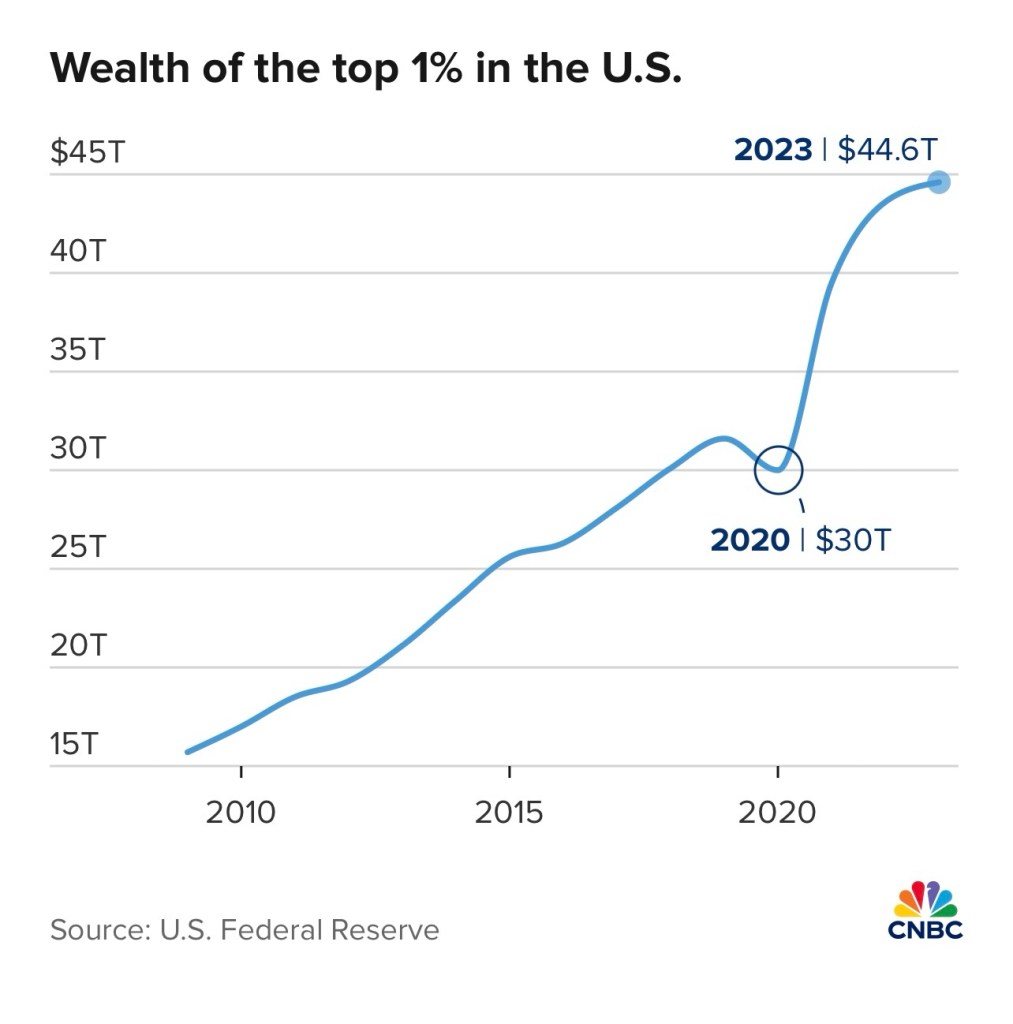
For a different visual representation of the disparity between ordinary Americans and the extremely wealthy, take a look at the video this links to.
One way this disparity has happened, and the CNBC article referenced above mentions it, is the stock market. While 62% of US adults invest in the stock market, the top 1% own 50% of it, worth $23 trillion. Cross-investing in one another’s interests has certainly helped the 1% amass so much. In addition to huge financial gains, this strategy has made them resilient through economic ups and downs, not only preventing their own collapse, but also collectively building an insurmountable bloc of massive wealth. Having relatively low taxes on income and stock returns further inoculates these billionaires from economic realities most Americans experience. It’s a (brotherly) band of billionaires, soon to be trillionaires as the trend continues.
Is this intentional? Likely not consciously so- at least that’s what I’d like to think. But I’m not so sure anymore.
Except for philanthropists such as Mackenzie Scott, Melinda Gates and, to some extent, Warren Buffet, billionaires haven’t been known for their charitable giving. Elon Musk has even criticized Scott for her philanthropy calling it “concerning” and “Reasons that Western Civilization died” (from a now deleted Twitter/X post). Buffet started The Giving Pledge to urge the 1 percenters to give away significant portions of their wealth. Mostly, this hasn’t worked and social issues like poverty, hunger and housing have grown.
In 2014, in a Ted Talk that’s getting renewed attention, Nick Hanauer, a billionaire, warned of the disaffection between the 1%, “his people,” and low and middle income Americans. He does remind that history has shown how times of great inequity as we see today have been solved: revolutions, protests, war. He believes only a thriving middle class can drive a great economy, not billionaires. An inequitable economy can only breed more unfairness. And that’s where we are today.
Disconcertingly, many of today’s billionaires are becoming engaged in politics. Musk has bought the presidency, according to many, and that has led to many jokes at Trump’s expense. Musk tried to thwart the government spending bill and he has been espousing many Project 2025 ideals- including that women should have more babies, following his own brood of 12, I guess. Never mind that most Americans cannot afford the expense of such a large family.
Trump has chosen 13 billionaires, the most ever, for his cabinet, and many have questionable qualifications and credentials. Already, 1 has dropped out and the rest have yet to be confirmed. Musk and Vivek Ramaswamy are leading an effort to cut government spending. They promise to cut the federal workforce by 75% and government spending by $2 trillion. There’s something disturbing- even grotesque- about one of the world’s richest men deciding to lay off mostly middle class and lower income workers and cut departments and programs supporting the poor, disabled, veterans and other disadvantaged populations. Will these changes help the middle class? No. The cuts are needed to fund and increase funding for tax cuts for the wealthiest, thereby continuing what Trump started in 2017.
In fact, extending Trump’s tax cuts would cost over $4 trillion. As it is, billionaires are $2.2 trillion richer because of Trump’s 2017 tax cuts, according to Americans for Tax Fairness. Musk’s fortune alone grew “eleven-fold,” and he’s not the only one.
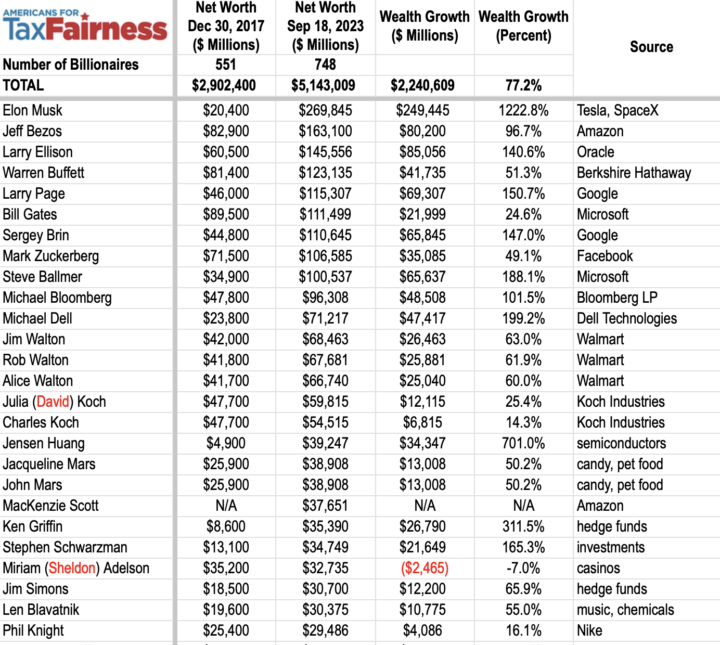
Looking at this list, I’ll remind you that all but one of these billionaires invest in each other, perpetuating a cycle of growth that benefits- only benefits- themselves. As Hanauer, a billionaire himself, notes in his Ted Talk, Trickle Down doesn’t exist. None, except for Mackenzie Scott, is giving money away. Most donate to their own foundations, which ultimately benefits themselves.
A recent example underscores this. So far only 1 billionaire has donated to helping California. Musk? No. Bezos or Amazon? No. Meta or Zuckerberg? No. Microsoft? Apple? That’s a negative. Who donated? Taylor Swift. She donated $10 million. I’m seeing a gender trend in donations…
Billionaires are 33 times richer than before the pandemic. All of that money is not in circulation, and that hurts our economy. Billionaires can potentially prevent money from circulating by accumulating vast amounts of wealth in assets like stocks, real estate, and investments, which can be money not actively being spent in the economy. This is often achieved through strategies like tax avoidance and loopholes, effectively removing money from circulation and contributing to wealth inequality. In addition, by holding large shares of companies (each other’s companies), billionaires can influence stock prices, potentially impacting market dynamics and limiting investment opportunities for others.
Now do you see what I mean by band of billionaires? There may be something to this conspiracy theory.
I would love to hear from you, even if, especially if, you disagree. Perhaps we can bring back the American tradition of civilizedy debate. Please like and share this blog with others. Subscribe to receive it by email and go directly to the Walk the Moon website to peruse the full collection of articles and updates.
 Walk the Moon
Excellent read
You nailed it about them wanting to cut programs that help people. Not sure what they gain from that except having blood on their hands. Disgusting! What Americans want is the opportunity to have a better life. To make a livable wage, to have fair prices, to have affordable education and to have healthcare.
if a billionaire wants to be grossly over the top rich that’s fine but leave us normal people alone!
LikeLiked by 1 person