A Raising Autism Blog
I’ve had a rough few weeks. I’m sick of Trump and the miserable state of America. I’m tired of trying to figure out how to protect my family from impending disaster. Do I live far enough from NY to avoid nuclear fallout? Or will radioactive ash rain down on our home and poison my family’s ability to survive devastation? Hypocrisy enrages me more and more every day. I cannot reconcile the dissonance and broken deductive logic of right wing belief systems. But what really has been difficult for me is something completely unrelated: raising neurodivergent young adult women.
I’ve shared before that I have two autistic daughters (I use autism intentionally. New research rejects the spectrum approach and replaces it with autistic types 1-4). Our journey has never been easy, but the transition from childhood to adulthood has been most difficult of all. Given all we’ve been through, that’s saying a lot.
I didn’t expect this challenge. Unrealistically, I thought our lives would get easier as their brains matured. I didn’t realize their neurodivergent differences would stall their maturation. Nor did I understand the emerging mental health issues. I blame my ignorance about these challenges on my overly optimistic expectations. Would better knowledge and awareness have helped me change what has happened? I fancy it would have. But I don’t know.
My younger daughter graduated high school early. In fact, she was almost two years younger than most of her high school classmates. She graduated high school with a solid GPA, a certification in medical assisting and an acceptance to a highly rated private school. She had played drums and fenced until COVID canceled these activities. Still, she was ambitious and enthusiastic, excited about living on campus, making friends and starting a new stage of life. During the summer, we shopped for her dorm room. She chose a black and white floral bedspread with accent pillows in various shades of blue. When move-in day came, my sister and I helped her decorate her room and get settled.
My older daughter had transferred to the same college and also lived on campus. Chuck, my sister and I got her settled too, then drove home without our daughters. “We did it,” Chuck and I breathed, excited for the time we’d now have to discover being a couple again. We had invested every resource into getting our daughters to this precipice of adulthood: countless medical appointments, support systems, and speech, occupational and mental therapies. We ferried them to group and private lessons for their natural music abilities. When horror struck—you can read about this in the early Into the Wilderness blogs—we dove deep into recovery. We gave everything to ensure success. Finally, we felt, we will see the results of our effort. The good days had come.
We were wrong.
Barely a month and a half into the semester, my younger daughter quit attending classes. What happened? She lost self-confidence and belief in herself. She saw the happy and social classmates making friends, navigating class schedules, finding their way around with ease. Totally frozen in self doubt, she measured herself as less. She crawled under her elevated bed into a dark space she’d created in the corner for herself. She slept and cried.
Her sister finally confided to my sister, their aunt. By the time I learned about the situation, my daughter’s first semester and $30,000 in tuition were lost. We drove back to campus, packed her up, leaving ramen warmers and fans in our haste, and came home. She retreated to her room, hoveled into layers of quilts and disappeared.
My husband and I were back to parenting full time.
She had taken a leave of absence from school rather than a withdrawal. Part of this was enrolling into an intensive day-patient therapy program. The program required 5 hours of therapy— individual and group— and classes on coping mechanisms and other tools for another 3. She’d rise in the morning just in time to dress, trudge to her car for the short drive to the program and arrive for 10 am check in. The program, used all the emotions and language she had available for the day. She’d then come home exhausted and crawl back into bed.
The program helped, however. Every once in a while, she’d emerge, a half-smile on her face, with a piece of wisdom from her program to share. This effort was just enough to seduce us into thinking this setback would be temporary.
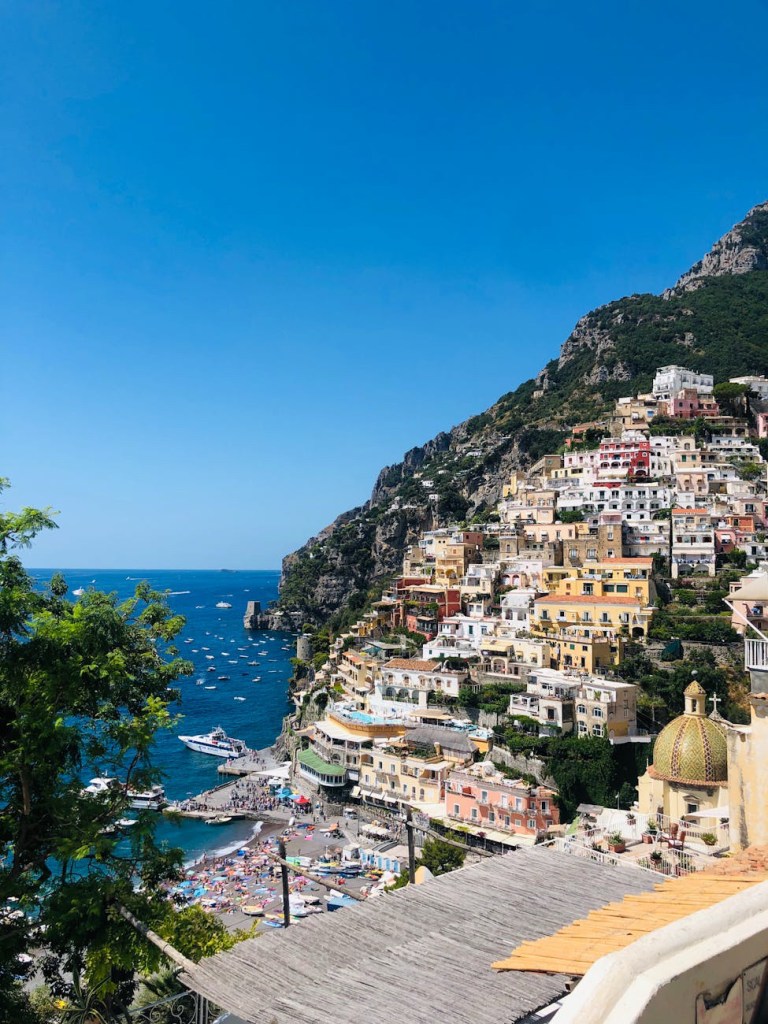
Excited about her progress Chuck and I planned a trip to Positano, Italy. We had not had any time as a couple for years and needed a private moment to reconnect and reset. We needed to dream together again.
Four days before leaving, however, our daughter imploded. Angry at her sister for not spending enough time with her, she screamed, “I hate you” at all of us. She threw her books to the floor of her room. She tore her unique artwork into pieces and floated the pieces over the second- floor banister. She wanted her sister to fill the gaps of friendship she was missing. This couldn’t happen.
Determined to go to Italy, I improvised. I decided to bring her with us, using points to get her on our flights. We already had big enough rooms for her to join us. I hoped the sea air of Positano would rally her.
Our first day, we landed in Rome and took the train to Napoli, or Naples as it is commonly called. Ancient Napoli populates steep hills. The shops line the vertical paths. In the evening, we climbed the worn and sometimes graffitied pathways into the inky apex. Along the way, we stopped in leather shops, in search of a new blazer to replace the one I had previously bought Chuck in Rome. Unfortunately, he had lost it on one of our trips. We didn’t find the blazer, but found handmade belts and wallets. Around 9 pm, we discovered one of Napoli’s most famous pizzerias. Serenaded by Italian love songs, we ate charred pizzas, drank smooth red wine and finished with sharp Sambuca. The food lulled all three of us into believing our problems were past us. Tummies full, slightly buzzed, we imagined our problems solved. We wove our way down the steep streets and back to the hotel. Tomorrow, we’d head to Pompeii, my second visit to the ruin and my husband and daughter’s first.
We had hired a local driver to take us from Napoli to Pompeii and then on to Positano. We’d drive through Sorrento, the beginning of the Amalfi coast, on our way there. Pompeii is a frozen horror set— if you imagine how the ruins came to be, that is. The people shells, forever locked into misery, depict the most tragic moment of the original humans’ lives. This was their last moment on earth, as they tried to shelter children, lovers and dogs. The entire uncovered town comes to life, showing the inhabitants’ daily habits— where they cooked, shopped, read, gathered, pottied and made love. We ended our tour with visiting a shop of replicated jewelry, the originals unearthed from the rubble.
We had coasted the wave of hope all day long. Our daughter was meant to come with us, I thought. Italy was a new beginning. She would carry Italy’s history and goodwill with her, embedded in her heart as a promise of rising, like Pompeii, from the ashes.
We arrived in Positano in the evening. It was January and the sea air was frigid, whipping our hair about our faces. We checked into our apartment and headed down the mountain into the town’s center for dinner. It was off-season for Positano. We wanted this. We wanted to feel like natives, seeking out the places they use when tourists aren’t present. Exactly in the heart of the village, we found an open trattoria. It had what we needed: wine, pizza, pasta and cannoli. We bought a bottle of limoncello and canned versions of Apperol spritz before climbing hundreds of cliff side steps to our apartment. Day One was over, a success. Full of good food, love and the expectancy only traveling provides, we piled into our beds, eager to explore more the next day.
The next day, our daughter could not get out of bed. She had fallen into the darkness once again. My husband and I wanted to enjoy our time together, so we headed back down the mountain into town to explore the shops. Our mission was to buy the blue and white pottery characteristic of the Amalfi coast. I was looking specifically for a shop I had visited previously. We found it. We walked inside the shop and started browsing. The owner, surprised to see us, said, “oh we’re closed.” I told him that this was my favorite pottery store in Positano and that I had visited it years before and was here to find more pottery. Hearing this, he allowed my husband and me to browse the store while he and his partner did inventory. My husband and I found vases, pitchers, candlesticks and other pieces in the store. The owner wrapped them up to ship back to New Jersey.
My husband and I spent almost the entire day in the town. We found a Trattoria perched on the edge of a cliff and ate lunch. We shared a huge bowl of pasta with seafood, and a bottle of white wine. In the late afternoon, as the sun shined brightly against the white washed buildings, we started our trek back up the mountain, climbing the same steps as the night before. Laden with bags of food and treasures bought in town, we could only manage 20 steps or so before needing to stop and rest. Our heavy load made climbing all the hard harder.
When we arrived back at the apartment, we found our daughter still in bed. She had not risen the entire day. I had hoped to coax her out for dinner. I had made reservations for 3 at a highly rated seafood restaurant. My daughter was lonely, however. She did not want us to leave. At the same time, she was unhappy and unpleasant to be around. She grumbled, “hate life” followed by “I’m a failure. I’ll never make anything of myself.”
After several hours of this, I unscrewed the limoncello. Her unrelenting despair unravels me and sometimes I’d seek to forget. Not realizing its strength, I poured an enormous glass, climbed to the patio on our apartment’s roof, where the beach glistened past the rooftops, and glugged it down.
I’m embarrassed to say I don’t remember much after this. One glass of limoncello, albeit generously poured, was enough to tip me. I do recall claiming hunger at about 9 PM, and finding no restaurants open, my husband and I joined the regulars at a local grocery/meeting spot/bar/café. We ate pizzas, again, and bought goodies for snacks. None would stay down. My husband teases me to this day that he had to prevent me from throwing myself accidentally off the cliffs as a stumbled along the streets. I can no longer drink limoncello, a travesty since I still have unopened bottles brought home from this trip.
The rest of the trip was like this with our daughter, except for one brief moment in Rome. We spent three days in the Amalfi coast, exploring the villages especially Positano. We then had our driver take us back to Rome where we would spend another day and night.
In Rome, I showed my daughter every sight we could fit in in a day—the Spanish steps, Trevi fountain, Palantine hill, the Vatican (from the ourside), St Peter’s Basilica, and countless squares. We ate salami and mortadella, gooey panini, gelato, biscotti, more gelato. We bought Italian coffee, olive oil and balsamic vinegar. What better to bring home from Italy than our favorite foods— and pottery, of course?
For dinner, we ate at a neighborhood restaurant recommended by the hotel and within walking distance. We were the only tourists in the place, making the meal all the more special. Within 24 hours, we would be home, buoyed, I hoped, by our short adventure. I hoped treatment followed by the Italian giro (tour) would boost her confidence and help her find her track.
Again, I was wrong.
At home, she began a cycle of fierce rage and depression rotating unpredictably each month. She crawled from bed some days with sunken eyes, wearing her misery across her flawless porcelain face. Her doctors experimented with medicines, none of which worked, all with horrible side effects and even terrifying interactions. She was stuck, lost and forgotten. Adulthood would have to wait. We had slipped back years. Finding her way back would be an arduous effort.
Read Part 2 next week to see what happens next.
I would love to hear from you, even if, especially if, you disagree. Perhaps we can bring back the American tradition of debate. Please like and share this blog with others. Subscribe to receive it by email and go directly to the Walk the Moon website (www.walk-the-moon.com) to peruse the full collection of articles and updates. You can email me from the Walk the Moon website as well.
 Walk the Moon