Into the Wilderness: Story 49
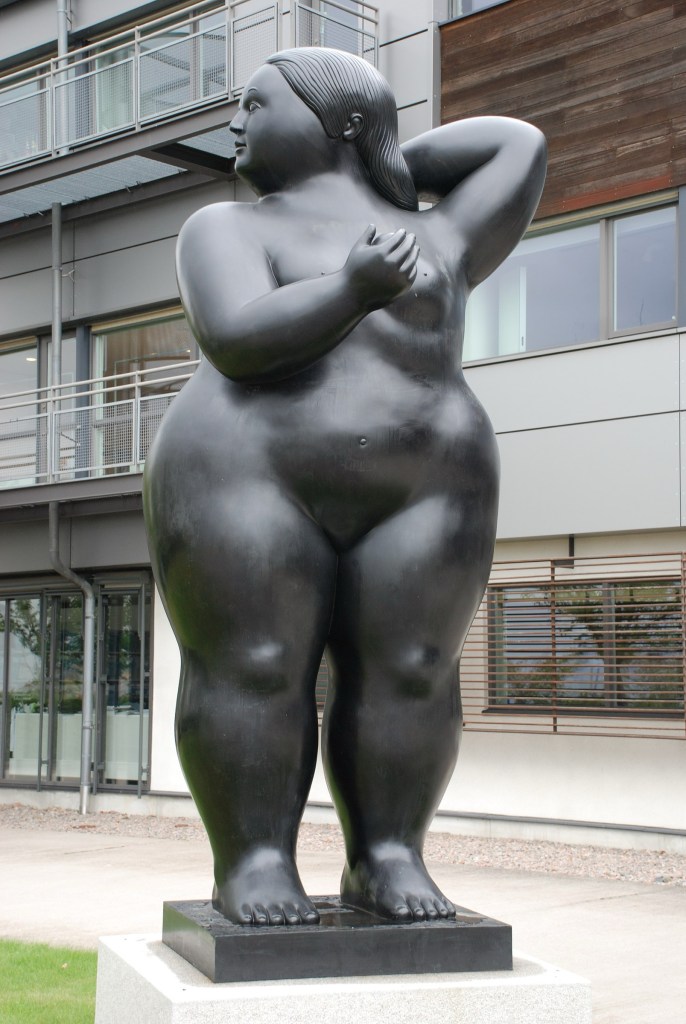
When you’re obese, you will always have a fat mind. Notice I said “mind.” Even if or after you lose weight, your mind cannot release the heavy tread of damage obesity causes. It’s two fold: society’s continual denigration of fat and one’s layers of fat shame deeply embedded in the psyche. The damage stays with you.
When I first became fat, it seemed sudden. One day I had been a petite dancer examining every body angle in the mirror. Another moment, I was encased in padding, separated from and protectively inhibited by my physical senses and emotions. This cocooned safety becomes obesity’s obsession and comfort. Society’s judgment is no longer close enough to harm and yet the micro harms burrow into the skin and fester.
I remember the first time I realized I was fat. The scale had told me, of course, but I had not been invisible before. I attended a party on Long Island with one of the friends I had made on my daily commute into the City. We had entered the party, my friend introducing me to each person. Their eye gaze never met mine. They said hello to an imaginary shadow hulking above my head. For the rest of the evening, no one saw me. I was the invisible woman silently sulking on the crowd’s edge.
One time before that, while still in Hawaii, when I was plumping slowly, I went to a club with my friend. A beefy guy hawked my tall, svelte friend. She completely ignored him. I was the desperate alternative, selected only for my proximity to beauty and not for myself. He continued to dance and talk to me- he even tried to kiss me- but I knew what he couldn’t say: I repulsed him. I gathered my ego about me and went home. That was my last visit to a club, and a party of any kind, until the moment on Long Island.
I marveled how people could not see me, not the real me. The young woman who loved literature, danced freely, remained sober to drive friends home safely, wickedly and good-naturedly joked, apologized and forgave wholly- she was lost.
What is it about extra pounds that repels people so? The thin aesthetic is man-made, literally. No other animal shuns a member for being larger, although overweight animals can be more at risk for predation. While fat shaming is not a feature of the natural world, disadvantages exist.
Some species gain from abundance. Larger animals can be viewed by other animals as more healthy and fertile. Animals in colder climates, for example, are better equipped to survive extreme temperatures. A skinny polar bear or seal is a vulnerable, weak and sick animal. Hibernating animals such as bears, some mice, squirrels and others are more likely to make it through cold months; their bodies draw upon their fat stores for sustenance.
These animals use fatness as a means of survival, not necessarily as a feature of attraction. The yellow-legged hornet is different, however. Males seek female hornets with larger bodies and legs. Marmots, found in mountainous regions in the Western US, are stuck in the mountains during cold months. They become exceedingly fat to survive the winter but this also has become a visual mating preference. Plump female marmots are more likely to reproduce and sustain the species. Some cat species are more likely to be naturally chunky, but not the Cheetah. The Cheetah’s survival depends on agility and speed.
In nature, therefore, obesity is an evolutionary need, signaling resiliency and reproductive aid, and not so much preference.
Some human cultures revere obesity. Some African tribes and Pacific Island races view fatness as a sign of wealth, health and beauty. Mauritania takes this even further. Obesity is beautiful and marriage-age girls are force-fed food- called gavage- to fatten them for marriageability- though this act sounds patriarchal and abusive.
Then there is the Renaissance when curves were “in.” Paintings exhibit soft female bodies with smooth curves, soft skin, flowing hair. They are undoubtedly beautiful but hardly fat by today’s standards.
So obesity as a cultural preference is inconsistent. Today, fat fetichism is found within “kink” communities- sexual preferences for certain body features (feet, anyone?) or practices (dressing as dogs). Our pets are getting fatter too- resource abundance- and studies show humans think fatter animals are cuter.
While nature adores abundance as a symbol of resourcefulness, preparatory survival and predation protection, not all species seek this feature. So it is with humans. Some visually appreciate the beauty of curves, the softness of the female body, the sense of abundance, but they are unlikely to admit this. Studies suggest that societal standards shame men, in particular, for this preference.
The body positivity movement has only gone so far. It has expanded the range of size acceptability but it has not reduced the prejudice, stigma and shaming that occurs. Women with extra body weight take up more space in the physical world, obliterating social standards of women making themselves small. Large women threaten man leg spread, crossed arms and inherent belief in male right of way.
Likewise, as all Americans have grown larger, seat sizes on public transportation and airlines have not changed. Is this prejudice or simply capitalism at work? More seats=more money. It always comes down to money.
The shaming is real, however, and I have experienced it first hand. As a fat woman of dating age, I was invisible. Any interaction was with the shadow me 1-2 feet taller than I was. I’ve experienced the medical disdain from obesity- the absolute refusal to investigate real medical conditions because I was fat. Endometriosis? Of course not, you’re fat. A fever of 104 degrees? You’ll be fine but you’re fat. An immune deficiency? What am I doing to lose weight? Blood work perfect? Can’t be, you’re fat. I’ve heard it all.
Our healthcare system wants people to be fat. They refuse the cost of new weight loss drugs and pay more for obesity complications. The long term medical costs are astronomical- humongous! But if insurance paid for medication, they lose the cost of catastrophic illness. It’s a complex algorithm whereby health is worth less than keeping Americans sick.
I am no longer fat and haven’t been for a while. I weigh 120-something pounds (damn pictures don’t do me justice). My brain, however, tells me otherwise. You’re fat, the whisper says. I’ve had enough work in CBT, DBT and cognitive restructuring to know what to do. But what I’d really love is a society neutral about weight, a love of differences rather than homogeneity. As a society, our intolerance has grown rather than dissipated.
And so my brain daily processes fat freedom- ever more fleetingly with my discipline. I will continue to do this work and appreciate my body, no matter where it falls on the scale.
What do you think?
I would love to hear from you, even if, especially if, you disagree. Perhaps we can bring back the American tradition of debate. Please like and share this blog with others. Subscribe to receive it by email and go directly to the Walk the Moon website (www.walk-the-moon.com) to peruse the full collection of articles and updates. You can email me from the Walk the Moon website as well.
 Walk the Moon