Into the Wilderness: Story 44
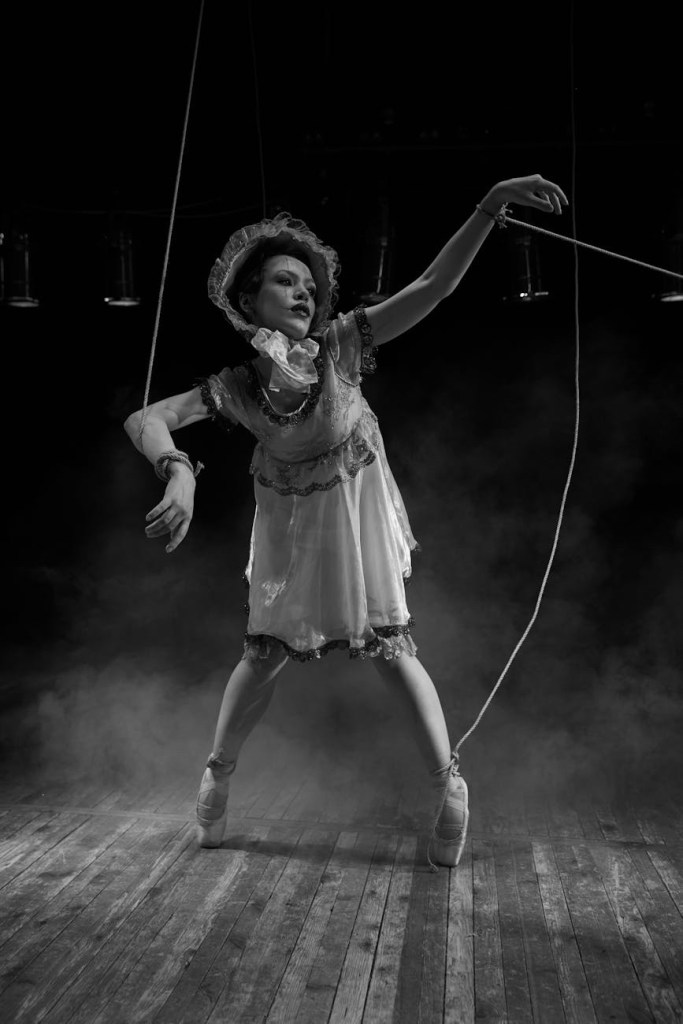
At night, I struggle to sleep. I start my routine, washing and scrubbing my face, layering, vitamin C, snail mucin, hylaraunic acids, retin A and serums across my face. This is as much a way of separating day from night as it is an anti-aging regimen. Each elixir layers me toward slumber. After, I climb into my too-tall bed, my dogs nestle beside me, one next to my right leg always lovingly licking the day’s salt from my knee. I turn the light off thinking, “tonight I will sleep.” My husband immediately breathes rhythmically. I begin tracing strings.
These strings are all of the possible life routes I could have taken. I trace each one wondering if my route is really self-determined or propelled rocket-like toward my life’s end.
Life only moves in one direction. What are the deciding moments called, for they are more profound than choices? Free will, a term I’d flush into the sewer, sounds as if all choices are one-dimensional, a step left rather than right or right rather than left, a simple diversion. Really, these eleven-dimension moments terrifyingly determine a life, the puppeteer strings maneuvering a life force. How can we not wonder about the propulsion of one decision over another?
I have so many.
There’s ballet class in 1981.
In junior high and high school, I took ballet class four to five times a week. Here I am at the barre, head, shoulders, back, hips, legs, feet aligned; my hand lightly touches the wood bar bolted into the wall, a wall to wall mirror reflecting every imperfection. The ballet instructor pulls me out of the preparatory class pushing me toward the sacred doors of the company class. Master Jazinski, a Balanchine protege, leads this class. I squeeze myself into a new barre space, hoping to avoid his terrifying gaze and cane.
After the barre, Master demands ballet combinations, grouping us into 4s. Using the ballet terminology of counts and hand gestures, he mimes a pirouette sequence, multiple turns from fifth into precise ballet positions- en dehors or en dedan. A company dancer in the group before me falls off point again and again. Mr. Jazinski pauses the music and hooks his cane around her skinny leg, pulling her into the room’s center. I know this lonely space feels like an interrogation spotlight.
“Do again,” Master says in Russian-accented English. She tries again. She falls again. She tries over and over. Tears smudge her mascara and her nose becomes stuffed with despair. She repositions herself. She falls. Master reprimands her and time expands on the clock of shame.
When my group is called forward, we hustle into position. Two tall dancers poise in front of me, their loose limbs so casual and certain. I try for an angle to hide behind their lithe legs. I position my feet, opposite but flat against each other. I focus my line- how my head flows to my neck, my neck to my spine and my spine to my tailbone, buttocks rolled slightly forward and tucked tightly. This is the dancer’s foundation- controlling every muscle to create explosive movements that look easy but are incredibly hard.
The music starts- an actual piano player in those days. I spin. And I spin. And spin. Four times. Each landing is strong. I don’t wobble or tilt or fall. I land softly yet precisely firm. I see Master watching me. Our eyes connect. He has no expression.
When I finish, I look at Mr. Jazinski again, perhaps hoping for praise. Nothing is there but the continued stern stare. Had I done well? I knew I had. I’d done more rotations than I’d ever done before. Was he impressed? He didn’t look as if he were. No other dancer that day does four perfect turns over and over again. It is a life moment. My future hangs on this very moment.
The next day when I come to ballet class, I automatically enter the preparatory room. I think I will be pulled out again. I think “this is how it goes.” Master’s wife- we call her Ms. Larkin- teaches the preparatory class. She doesn’t like me: I am short with thick muscly legs, very different from tall, willowy Balanchine dancers. I expect Ms. Larkin, one of the first Native American ballerinas along with Maria Tallchief, to say, “what are you doing here?” as she has with others. Instead, she says, “it’s hard, isn’t it?” I say nothing. I had not found it hard. Do I say that? I don’t. And that is it. I remain in the prep class for weeks until I begin to pull away from ballet. The life moment wasn’t toward a future in ballet. It was the beginning of the end. I will eventually be back in the master class, but my moment is gone.
Here’s the string I want to pull: What if I had had the confidence to take myself the next day to the company class? I had done the moves. I had hit the marks. I was good. Instead, I waited for external validation never granted. The string dangles, a moment of self-doubt cutting my path rather than the master class success.
See how these strings work? We all have them. They entwine our aging arms and legs becoming tighter with each decision. There’s the boy or girl we didn’t choose, and the ones we did. There are jobs we took or refused and moves across town or country. There’s one class or degree over another. One compromise, one extravagance, one indulgence or self-deprivation. They all decide the way. For with each decision, our future becomes more and more predictable, the sum of all that came before rather than empty possibility.
And so I pull another string, perhaps one to fulfill dreams and create new. The future is here, inside me. I uncoil my strings and hurl them into another dimension.
I would love to hear from you, even if, especially if, you disagree. Perhaps we can bring back the American tradition of debate. Please like and share this blog with others. Subscribe to receive it by email and go directly to the Walk the Moon website (www.walk-the-moon.com) to peruse the full collection of articles and updates. You can email me from the Walk the Moon website as well.
 Walk the Moon