A Surviving Facts Blog
Eleven companies own almost every food product we purchase.
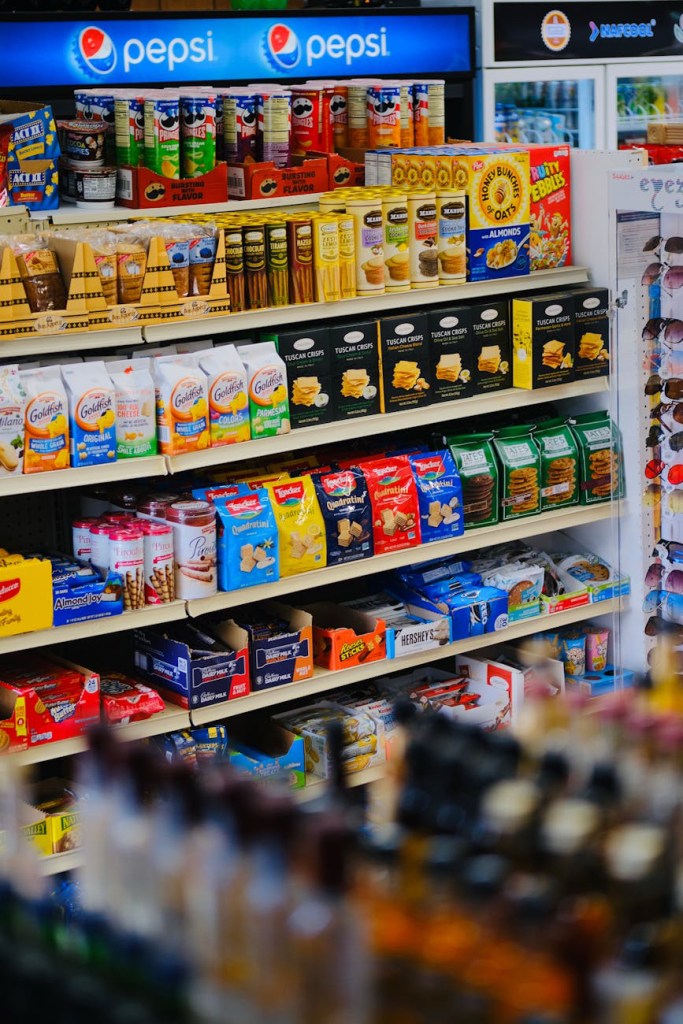
The companies include Pepsi-Co, Kellogg’s, Mars, General Mills, Mondelez, Johnson & Johnson, Nestle, P&G, Danone, Coca Cola and Unilever. Collectively, these commerce giants, also known as “mega companies,” own and produce thousands of products. Go to any grocery store and read the fine print. You’ll be surprised to find:
- Mars makes M&Ms, Skittles, Altoids, Uncle Ben’s and Seeds of Change, among many others
- Mondelez (formerly Kraft) produces Cadbury, Trident, Halls cough drops, Oreos, Chips Ahoy, Fig Newton’s, BelVita, Nabisco, Triscuit, Ritz, Snackwell’s, Kraft Cheese Cups, Velveeta, Philadelphia cream cheese, Tang, Maxwell House, Toblerone and countlesss more.
- General Mills isn’t just a cereal manufacturer. They also develop Betty Crocker, Pillsbury, Yoplait, Bisquick, Nature’s Valley, Old El Paso, Progresso, and Green Giant, plus many more.
- Coca-Cola owns more than 200 brands. Sparkling waters, soft drinks, teas, milk, juices, coffee, sports drinks- the list goes on and on. They even own a Jack Daniels and Coca-Cola mix.
- Nestle, the behemoth of them all, brings to market Coffeemate, Toll House, Carnation, Nespresso, Nescafé, Power Bar, Gerber, Good Start, Perrier, Pellegrino, Poland Spring, Juicy Juice, Stouffers, DiGiorgno, Hot Pockets, Buitoni, California Pizza Kitchen, Dreyers, Wonka Candy brand and more than 28 candy bar brands- and this is simply a sampling of their brand portfolio.
How many of these items are regularly in your grocery cart? I’m a pretty savvy shopper, but I’ll admit Triscuit, Maille, Hellman’s, Pellegrino, Santita’s, Philadelphia cream cheese and others are often in mine.
Why does this matter?
We are feeding the monopoly monster. With so much money concentrated in a few corporations, our market of choices shrinks rather than grows. We may think we are supporting newly formed companies or companies that have certain values based on their origination, name or description. This is just marketing, however, aimed at creating brand loyalty to an image. For example, are you supporting a green company when purchasing Innocent Kids or Fuze Tea? Nope. You’re supporting Coca-Cola, which has been accused of being the world’s largest plastics polluter. This is why it matters.
Before we go further, let’s take a look at basic economics.
We all (well, many know) the basic economic principle of supply and demand. Simply put, it correlates the price of a good or service with the availability of the product and the desire of the consumer to purchase it. If a lot of consumers want a new tech gadget and it’s not available, the prices will go up when manufacturers produce more. When consumers no longer want that gadget, and it languishes on store shelves, the price goes down. Basic economics.
With monopolies, however, the correlation between supply and demand becomes skewed. A finite set of monopolies establishes the market and all its attributes. In other words, the market becomes a tool of the few rather than the share of many. Consolidating so many products in a limited set of companies controls product choice, availability and price.
When consumers talk about soaring food prices, they should look at these companies. Monopolies produce false competition- a fake market of competition. The monopoly competes with itself. As long as they perpetuate this charade, they can create demand and raise (or reduce- though that hasn’t happened) prices.
This is why breaking into the food business is so hard. Small companies have limited resources to buy supermarket shelf space (it’s not free), advertise nationally and produce with consistency. Big food conglomerates, on the other hand, can gain prime shelf positioning, target advertising to selected, most-likely-to-buy customers (identified by thorough and expensive market research) and manage the supply chain. They control the supply chain- which is one reason supply chain issues over the past several years make no sense. It’s an opportunity to create customer desire by creating a market gap.
Just as billionaires control the stock market and big company ownership (see my blog on Band of Billionaires), the conglomerate food and product companies do the same with food and beverages.
Increased food costs matter. This concern led to half of voting Americans choosing “economy” as a reason to vote Republican. The message was that the rising costs of living, including the cost of food and gas (gas, ironically, was at its lowest in years and has increased since Trump took office), mattered more than protecting basic human freedoms.
Several factors increase food and beverage prices- natural disasters, diseases, war and crop yields. These, however, are usually isolated incidents in which a temporary increase occurs before correcting itself. Egg prices, for example, are soaring due to the H5N1 “bird flu.” Farmers are having to slaughter thousands of chickens, reducing the amount of hens capable of laying eggs. It will take a year- until spring 2026- to develop more egg-producing hens- and that’s only if H5N1 is controlled (hint: right now it’s not).
Currently, tariffs are increasing prices. Trump has put tariffs on goods imported from China, Canada and Mexico. Theoretically, tariffs are supposed to do more than raise costs. They also are intended to restrict demand and reduce competition. Some also believe they could lead to increased employment. Historically- for example, the 2018-19 steel industry tariffs- they have had the opposite effect: fewer jobs.
The irony of increasing prices due to tariffs, however, is that the 11 conglomerates mentioned in the first paragraph, are global companies. They could actually rev up demand in other markets to offset some impact from US tariff costs. It’s these companies raising prices- with tariffs as the incentive. They could try to inoculate the consumer by leveraging their global footprint, by reducing other controllable expenses or by choosing to make less revenue (revolutionary, I know). I’ve yet to see any company make these choices.
Nor have I seen any reduction in CEO compensation. General Mills’ CEO made $12.8M in 2024. The largest share came from stock. However, the CEO has a $1.3M base salary and received $1.2M as a bonus. Meanwhile, the average production worker at General Mills earns around $21 per hour or $60,000 annually (if you’d like the full range, go to Glassdoor). Between the CEO and the average worker, which is more likely to lose a job due to inflation- remember job loss has historically been an outcome of inflation? You get one guess.
Unfortunately, our current pro-corporation government is unlikely to protect consumers from the abuses of mega corporations. Prices started climbing even before tariffs were put in place. A lot of Trump supporters, expecting lower food prices, are now finding this out.
In the past, the government has acted to prevent monopolies and price fixing. For example, when the airlines were accused of price fixing, the Department of Justice forced six of the largest airlines to make changes in a pricing system collectively used to increase ticket costs. It’s likely this same kind of collective pricing is occurring in the food industry. Kamala Harris pointed this out during her short campaign and promised to take action. We all know what happened next.
These comprise the underpinnings of an economic system of inequity. The billionaires own the companies, a finite set of companies own the products, the companies reward executives at the top, and the average worker is at risk from the decisions made through this system. The impact ripples to the average consumer who pays more for everyday goods. Their budgets get tighter, and day-to-day living becomes harder. The so called “trickle down” is really a waterfall pelting the consumer with expense. It’s a fight for survival.
As you pay for more for products, remember the system that enabled it. And while you’re at it, reflect on why corporations and billionaires need limitations placed on them. They have seemed unable to do so themselves.
I would love to hear from you, even if, especially if, you disagree. Perhapstt we can bring back the American tradition of Ty debate. Please like and share this blog with others. Subscribe to receive it by email and go directly to the Walk the Moon website to peruse the full collection of articles and updates.
 Walk the Moon